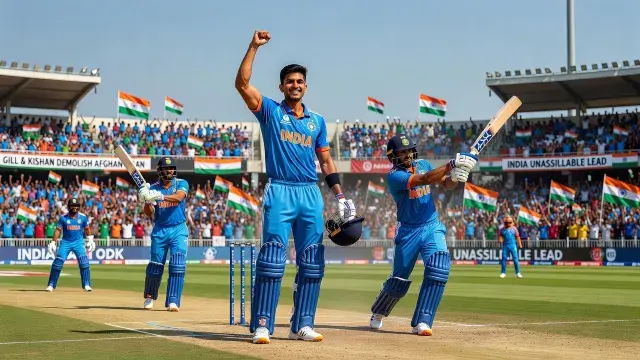
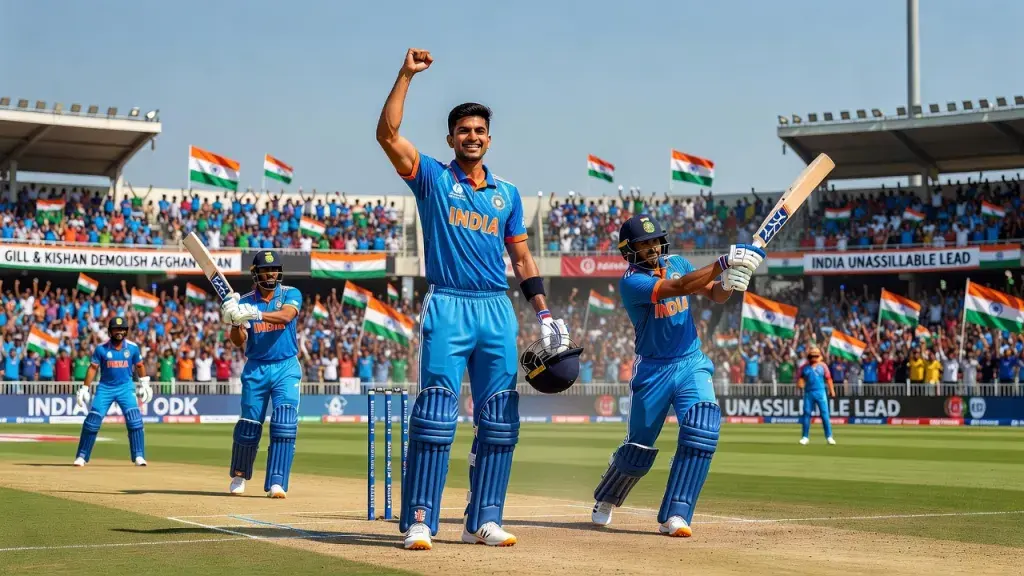
India sealed the three-match ODI series against Afghanistan with a match to spare, crushing the visitors by 170 runs in the second game at the Ekana Cricket Stadium in Lucknow on Wednesday. A dominant batting display anchored by captain Shubman Gill's 154 and Ishan Kishan's blazing 125 set up a total of 402, which India's pace attack then defended with clinical efficiency, bowling Afghanistan out for 232 in 44.3 overs.
The contest was effectively decided in the middle overs, when Gill and Kishan produced a partnership that left Afghanistan's bowlers - and the fielding side's strategic thinking - with nowhere to turn. The pair added 224 runs in just 140 deliveries at a strike rate that few modern ODI sides sustain for that length of time. It was the kind of extended, high-octane batting assault that has become India's trademark at home, where conditions and depth allow captain and wicketkeeper to exchange roles mid-over without losing momentum. Much like fans of fast-paced competitive action seek out intense formats across entertainment - whether it is a dota berserk league clash or a white-ball run-fest - this partnership delivered a spectacle that demanded full attention from the first ball to the last.
Gill's innings was particularly significant beyond the scorecard. He reached his ninth ODI century off 77 deliveries, accelerated to 150 from 108 balls, and finished with 154 off 110, hitting 22 fours and two sixes. In doing so, he became the fastest Indian batsman to 3,000 ODI runs measured by innings - a milestone that underlines just how quickly he has matured into a genuine force at the top of this format. Kishan, meanwhile, was the aggressor in the partnership, reaching his century off 71 balls and finishing with 125 from 79, including 14 fours and seven sixes. India raced past 300 in 35.5 overs - one of the quickest such markers recorded by a side batting first in ODI cricket.
Afghanistan's Spin Gamble and Late Recovery
Afghanistan were not without ideas early on. Their decision to open with off-spinner AM Ghazanfar was a calculated surprise, and it contributed to an uncertain start for India - Yashasvi Jaiswal failed to find his rhythm and departed cheaply. Rohit Sharma, however, looked fluent and composed, threading the gaps with his characteristic ease before he was dismissed for 48 with the score at 80 for two. The departure of a batsman who had looked well-set is usually the moment a bowling side senses an opening. Instead, Gill and Kishan walked out and closed it firmly.
Left-arm spinner Nangeyalia Kharoti deserves credit for halting what threatened to become an even more overwhelming total. He dismissed both Gill and Shreyas Iyer - who contributed a brisk 26 - and finished with figures of 4 for 76 that reflected genuine quality rather than late-innings consolation bowling. Rashid Khan added three wickets as India lost their final seven wickets for 80 runs, a collapse that trimmed the total to 402 all out in 49.5 overs but came too late to change the shape of the contest.
Afghanistan Undone by Pace, Rahmat Stands Alone
Chasing 403 on a flat Lucknow surface, Afghanistan needed a fast, confident start. They got neither. India's pace bowlers struck consistently, disrupting partnerships before they could develop and keeping the required rate at a level that made the chase academic within the first fifteen overs. Arshdeep Singh led the attack with three wickets, and Gurnoor Brar matched him with three of his own. Debutant Prince Yadav also claimed his first ODI wicket, a moment of personal milestone within a team performance of considerable authority.
The one figure who refused to accept the inevitable was Rahmat Shah. His 79 from 89 deliveries was an innings built on technique and sheer determination - he played through cramps, kept finding the boundary, and gave Afghanistan's lower order something to bat around. When Rashid Khan arrived, there was briefly some entertainment in an increasingly one-sided contest. But the required rate was climbing past the point of any realistic hope, and Rahmat's resistance ended when he pulled Prince Yadav to fine leg and Brar completed a clean catch. Afghanistan were bowled out in the 45th over, and India had their series.
What the Result Means for India's Developing Core
With the third ODI still to come, India will have the opportunity to rotate their squad and assess further options - a useful luxury heading into any upcoming international schedule. More broadly, this series has provided meaningful game time for players operating at the fringes of the first-choice side. Brar's figures, Prince Yadav's debut wicket, and Kishan's return to form are all positives India's management will note. Gill's leadership, however, is the overarching story. He led from the front with a captain's innings, set the tempo, and allowed India's natural batting depth to express itself freely. For a side building continuity across formats, those are exactly the performances that matter.